Cattle country with a mine in it
Rural fencing in Blayney Shire is split between grazing properties and a growing number of small blocks. At the 2021 Census the shire had 7,497 people. Gold ore mining was its largest employer, and specialised beef cattle farming was third with 107 people (ABS QuickStats, Blayney local government area). Median weekly household income was $1,547. So the land is mostly cattle and sheep, while many of the people who live on it work off-farm.
That mix produces two kinds of fencing job. One is the long stock boundary on a grazing place. The other is the few hectares outside Millthorpe or Carcoar where someone wants horses, a tidy frontage and no barbed wire.
Cold, wet ground
This is some of the coldest farmed country in the region. The nearest Bureau of Meteorology climate site we could read is at Orange, which averages a July minimum of 1.6 degrees and 924 mm of rain (Bureau of Meteorology, Orange). We did not find a station for Blayney itself, so treat that as a guide. For fencing it means short working days in winter, ground that can be too soft for a tractor after rain, and timber posts that sit in damp soil for months.
Ask the contractor when they would plan to build and what they do if the weather turns. On posts, ask for the species and durability class or the treatment level, for the reasons set out in how long fences last.
Steep lines
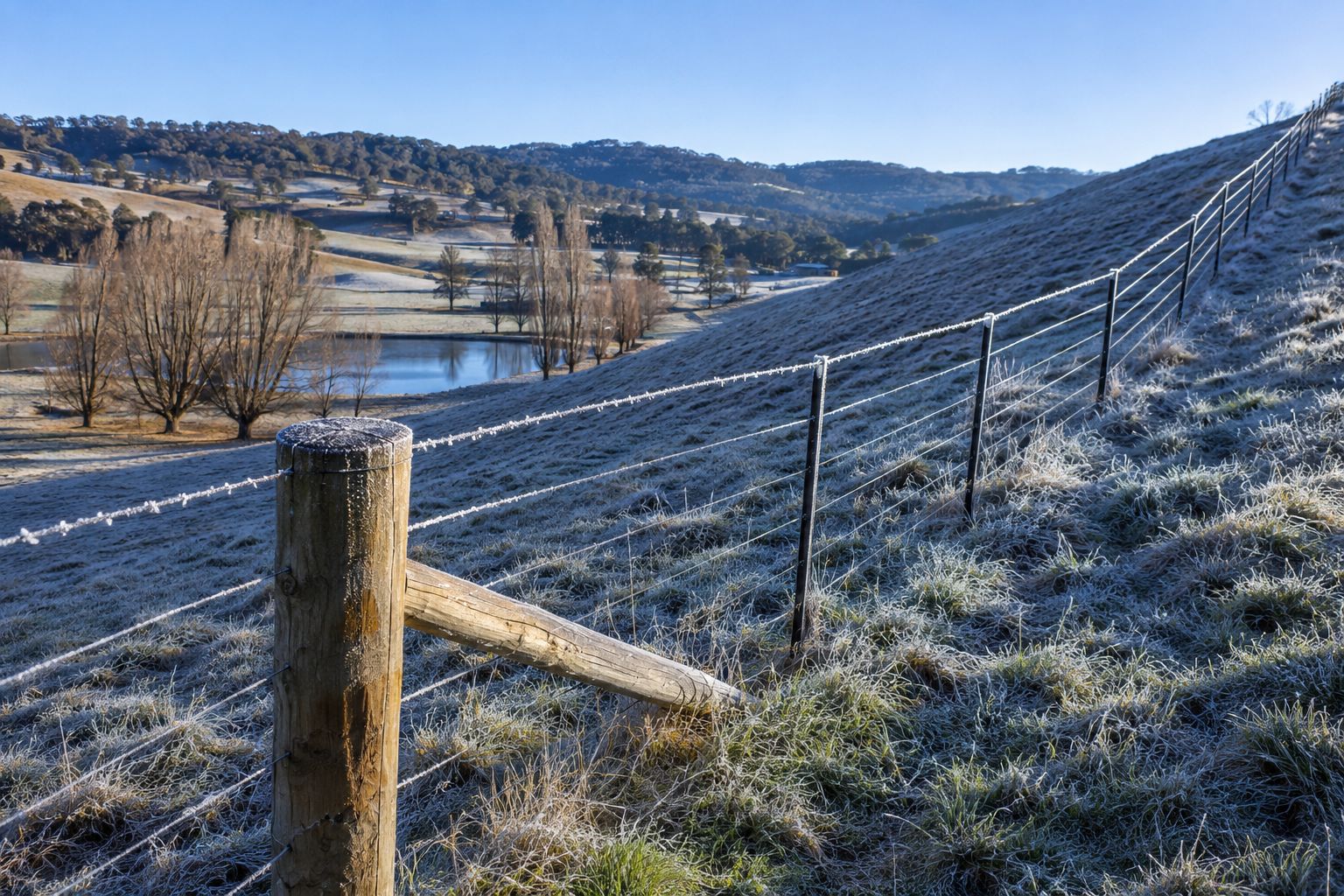
Much of the shire is properly steep, and steep fences are slower to build and harder on strainers. Where a line runs straight up a face, machinery may not be able to follow it, and posts and wire are carried in by hand. Where it crosses the slope, every dip needs a tie-down so the wire does not lift the posts out. A contractor who works this country will price those things in. One who does not may leave them out and find out later.
| On a steep line, ask | Why it matters |
|---|---|
| Can your machine get along the whole line? | Hand work costs more and takes longer |
| Where do the strainers go on each change of slope? | Each change in grade needs its own anchor |
| How are dips held down? | Wire tension lifts posts out of hollows |
| What happens at the gully at the bottom? | Runoff concentrates there and takes the fence first |
Small blocks around Millthorpe and Carcoar
Millthorpe and Carcoar are heritage villages, and that matters for fences. NSW planning guidance says the usual exemption for rural fences does not apply to heritage items or in heritage conservation areas (NSW Planning). If your block is in or beside either village, ask Blayney Shire Council before settling on a fence style. For the fence itself, horse and lifestyle block fencing covers rail, mesh and tape options.
The council also publishes its own plain-language fact sheet on dividing fences, which is a handy summary of how neighbours share costs (Blayney Shire Council fact sheet). It is a guide, not the law, so read it alongside our dividing fences page.
Vines and orchards on the fringe
A secondary source describes the Orange wine region as taking in the land above 600 m in parts of three council areas, Blayney among them (secondary source). Where a vineyard or orchard shares a boundary with a grazing paddock, the two owners want different things from the fence. Farm boundary fencing explains the usual way to split a base fence and the extras.
Getting it quoted
Send the locality, the stock or purpose, a rough length and a photo that shows the slope through the quote form. Slope is hard to judge from a description, so the photo does a lot of work here.
What this page cannot tell you
This page cannot give you Blayney's own weather record, because we did not find a station to cite, and it cannot say whether your block is in a heritage area. The census figures are for the whole shire. Nothing here tells you how a fence will stand on your slope. The contractor who walks it, and Blayney Shire Council for planning and heritage questions, are the ones to ask.
Check the current rules before you rely on this
This page describes the grazing country and small acreage of Blayney Shire and what affects rural fencing jobs there. It describes the rules in general terms as they stood in November 2026. Standards, forms, thresholds and fines change.
The authoritative sources are ABS 2021 Census QuickStats: Blayney (local government area), Bureau of Meteorology, Orange Agricultural Institute climate statistics (station 063254), NSW Planning, fences (exempt and complying development), Blayney Shire Council, dividing fences fact sheet (another council; secondary, illustration only) and Wikipedia, Orange wine region (secondary source). Where anything here differs from those sources, they are right and we are not.
We are not fencing contractors, builders, regulators or lawyers. For what applies to your fence, ask the contractor which licence or registration they hold for your job, then ask NSW Fair Trading or Building Commission NSW if you are unsure, and ask the council that covers the land.
Accurate at the time of writing, November 2026. Always check the source before relying on it.