Three separate questions
Whether you can just build a farm fence in NSW comes down to three separate questions: does the fence itself need planning approval, can you clear the vegetation in its way, and does the contractor need to hold a licence for the work. They are answered by different agencies under different laws, and a yes to one says nothing about the others.
1. Planning approval for the fence
NSW planning guidance says fences can be built without planning approval in many circumstances, as exempt development (NSW Planning). For rural zones, environmental zones and large lot residential land, the conditions it lists include:
- the fence is no higher than 1.8 m,
- it is post and wire or post and rail construction,
- masonry is limited to the area near a driveway entrance,
- any electric fence meets the relevant Australian and New Zealand standard.
Exempt status does not apply on heritage items, in heritage conservation areas or on some environmentally sensitive land. If the fence falls outside the conditions, the guidance says a development application to the council is needed. The page does not use the words "farm fence", so if you are unsure whether your fence fits, ask the council that covers the land: Orange City, Cabonne, Blayney, Cowra or Bathurst Regional.
| Situation | Likely position | Check with |
|---|---|---|
| Post and wire stock fence under 1.8 m in a rural zone | Often exempt development | Council, if heritage or sensitive land is involved |
| Tall exclusion fence over 1.8 m | Outside the exempt height | Council, before ordering materials |
| Solid or masonry fence along a frontage | Outside the exempt type, apart from entrances | Council |
| Fence on a heritage-listed property | Not exempt | Council |
| Fence in a road reserve or across a Crown road | Not yours to build without permission | Council or Crown Lands |
2. Clearing native vegetation for the fence line
Clearing is a separate system. NSW rules for rural land allow some clearing of native vegetation without approval for "rural infrastructure", and fences are on the list (NSW Government). The allowance is the minimum clearing necessary, up to a maximum width that depends on the zone the land falls in, with narrower limits for small holdings, short-term fences and vulnerable or sensitive land.
Three points catch people out:
- The maximum width counts clearing on both sides of the fence, including anything the neighbour has already cleared.
- The zone for a given property is shown on a government map, not listed by town. This site does not assign a distance to any locality.
- Paddock trees, creek lines and mapped sensitive areas can carry tighter rules than open country.
Local Land Services is the agency to ask about clearing on rural land. Do that before a dozer is booked, because clearing beyond the allowance is an offence and cannot be undone.
3. Electric fences
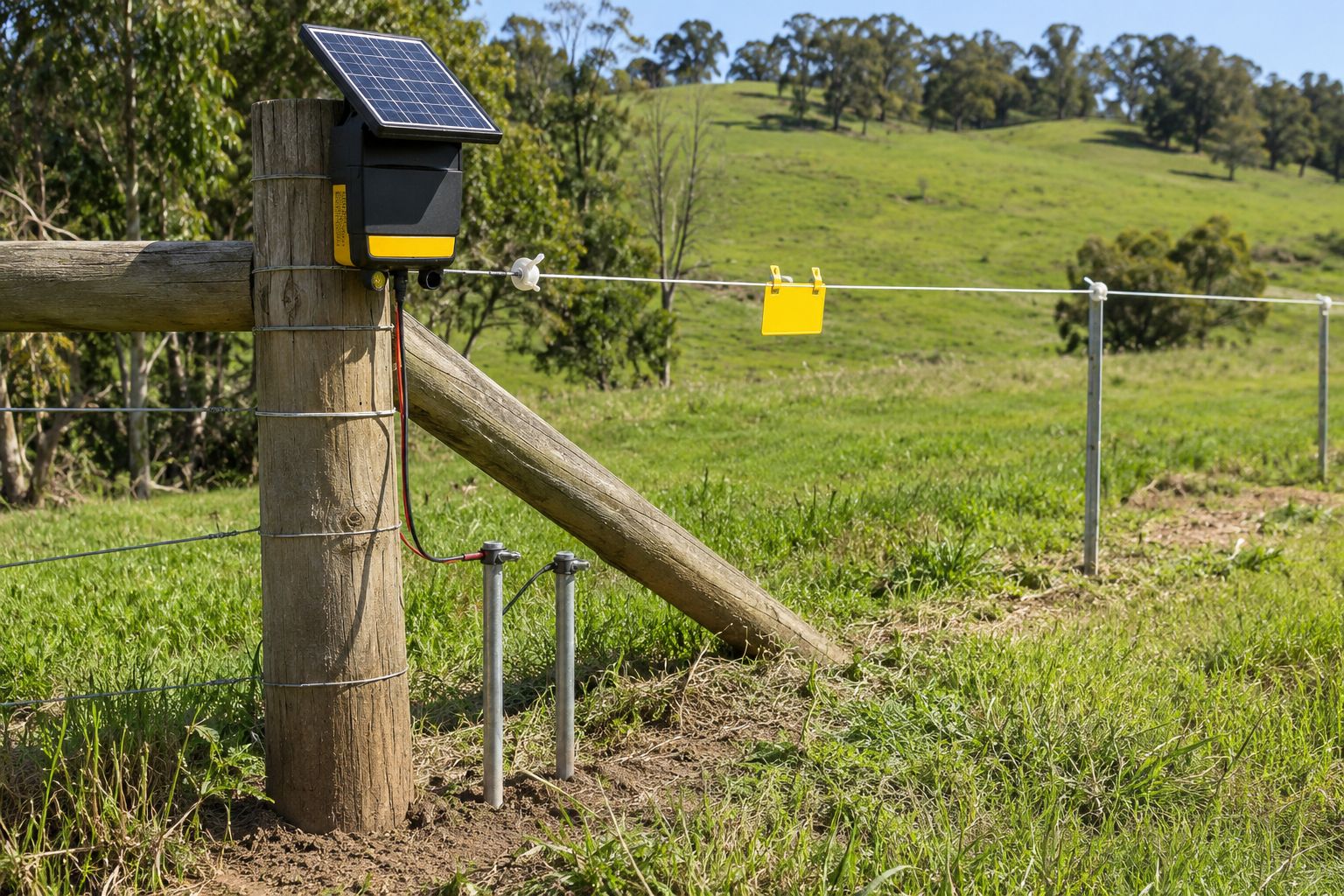
Electric fence energisers are covered by Australian and New Zealand standards, and the planning guidance makes meeting the standard a condition of exempt development. The standards have been revised, and a New Zealand regulator's page describes a newer energiser standard replacing an older one (a New Zealand regulator, secondary source). We did not read the standards and cannot say which edition NSW authorities apply. Ask the contractor which standard the installation meets, and how warning signs are handled where the public can touch the fence. Electric fencing covers the practical side.
Licensing is a different matter again
Nothing in the planning or clearing rules tells you whether the person building the fence needs a contractor licence. On that, the only NSW Government page we found speaks about fencing on residential property boundary lines and does not mention farms. This site does not say either way. The contractor guide sets out what to ask.
Fire season and hot work
Burning cleared timber, and welding or grinding on a fence line, bring in fire rules. The NSW Rural Fire Service says fire permits are free, need to be arranged ahead, and are required for burning during the Bush Fire Danger Period, which generally runs from 1 October to 31 March but varies by area and season (NSW Rural Fire Service). Check current fire danger ratings and restrictions for your district before any hot work.
A sensible order
Ring the council and describe the fence. Ask Local Land Services about any clearing. Talk to the neighbour if it is a boundary, using the dividing fences guide. Then get the job quoted through the contact page, and tell the contractor what you were told.
What this guide cannot confirm
This guide cannot tell you that your fence is exempt development, how wide you may clear on your land, or which electric fence standard applies today. Planning controls differ between council areas and zones, clearing limits depend on mapping we cannot read for you, and standards are updated. Treat this page as a list of questions. The answers come from the council, Local Land Services and the contractor.
Check the current rules before you rely on this
This page describes NSW planning guidance on exempt rural fences, the allowance for clearing native vegetation for fences and the conditions that apply to electric fences. It describes the rules in general terms as they stood in November 2026. Standards, forms, thresholds and fines change.
The authoritative sources are NSW Planning, fences (exempt and complying development), NSW Government, native vegetation allowable activities (rural infrastructure, fences), New Zealand building authority, AS/NZS 60335.2.76:2019 electric fence energisers (secondary; New Zealand; status in NSW not confirmed), NSW Rural Fire Service, fire permits information for rural landholders and farmers (PDF) and NSW Government, fencing work (licences and credentials; speaks about fencing on residential property boundary lines). Where anything here differs from those sources, they are right and we are not.
We are not fencing contractors, builders, regulators or lawyers. For what applies to your fence, ask the council that covers the land about planning, Local Land Services about clearing, and the contractor which licence or registration and which electric fence standard apply, then ask NSW Fair Trading or Building Commission NSW if you are unsure.
Accurate at the time of writing, November 2026. Always check the source before relying on it.