Licences and insurance first
Licensing rules differ by job. The NSW Government fencing page we found speaks about fencing on residential property boundary lines, and we could not confirm that it covers rural or farm fencing. Ask the contractor which licences and insurance apply to your job, check NSW Government licence guidance, and ask NSW Fair Trading or Building Commission NSW if you are unsure.
That page is the NSW Government fencing work page, and the related categories of work page lists fencing work without mentioning farms or paddocks either. So this guide does not tell you what a contractor must hold. It tells you what to ask, and the contractor is responsible for holding any licence or registration that applies.
On insurance, ask to see a certificate of currency for public liability, and ask how workers on the job are covered. A contractor who is set up properly will have both to hand.
Ten questions worth asking
| Ask | Listen for |
|---|---|
| Which districts do you work, and how far out is my place for you? | A straight answer about travel and whether it is priced in |
| What fences like mine have you built nearby that I can look at? | Jobs you can drive past, on similar ground |
| Who will be on site, and are you there yourself? | Whether the person quoting is the person building |
| What exactly are you quoting: wire, grade, posts, spacing? | Product names and numbers, not just "stock fence" |
| Where will the strainers go, and what are they made of? | Species or treatment class, and how they are stayed |
| How will you handle the gully, creek or rock on my line? | A plan for each one, and how it is charged |
| Who checks for powerlines and underground services? | A clear answer about who arranges it before digging |
| When could you start, and what would delay you? | Honesty about weather and other jobs |
| How is payment staged? | Deposit, materials, progress and final payment in writing |
| If a wire slackens or a post lifts in the first months, what do you do? | Whether they come back, and whether that is written down |
None of these are trick questions. A fencer who has been doing it a while will answer most of them before you ask.
Reading the quote
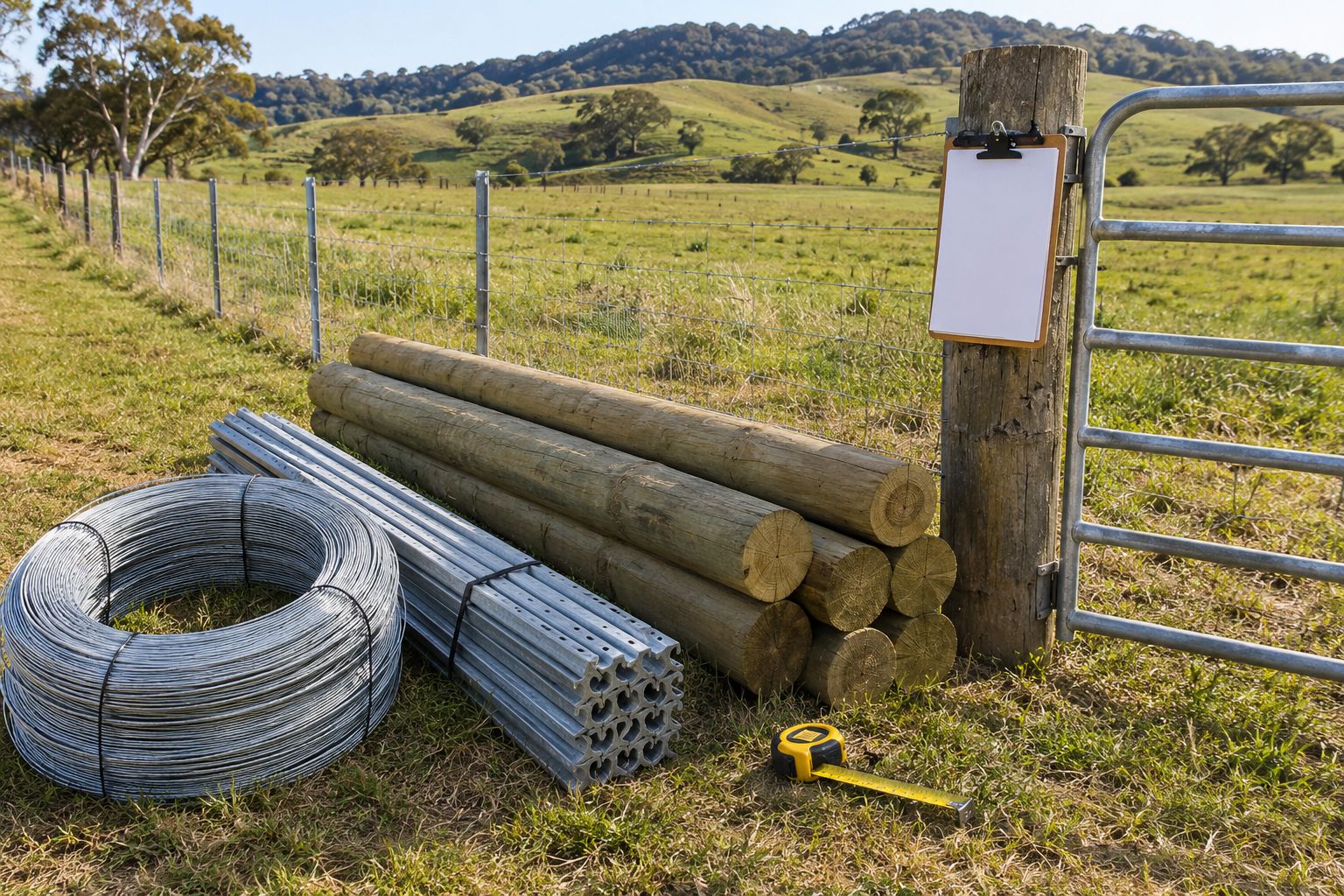
A good rural fencing quote is itemised, written and specific enough that someone else could build the fence from it. Check that it states:
- the length quoted and how it was measured,
- the fence type, wire product and grade, and the number of wires,
- post material, size and spacing, and the strainer and stay details,
- every gate, with its width,
- each crossing and how it is built,
- whether the old fence is removed and where it goes,
- what happens if rock or boggy ground is found,
- who supplies materials,
- the payment stages, and
- the licence and insurance details the contractor says apply.
If the fence is on a boundary, ask for the quote to be addressed to both owners, with any extras one owner wants shown as separate lines. Farm boundary fencing explains why.
Safety is your business too
Fencing uses post drivers, augers, tractors and wire under tension, on your land. SafeWork NSW's farm machinery guidance stresses guarding on post hole diggers and power take-offs, rollover protection on tractors and trained operators (SafeWork NSW). The regional electricity network operator says to stay at least 8 m from a powerline and anything in contact with it (network operator safety guidance). Point out powerlines, buried pipes and anything else you know about along the line before the first post goes in.
Warning signs
Be careful with a contractor who will not put the quote in writing, wants full payment before starting, cannot name a job you can look at, is vague about what wire or posts they use, or tells you no neighbour, council or service check is needed without asking where the fence is. None of those proves bad work. Together they suggest a job that will be hard to sort out if something goes wrong.
Finding one
Many rural fencers around Orange get their work through other farmers and are hard to find online. That is the gap this site fills: describe the job on the quote form and it is passed to a contractor who works your district. You are free to get other quotes as well, and the cost factors guide will help you compare them.
What this guide cannot do
This guide cannot vet a contractor for you, confirm that anyone holds a licence, registration or insurance, or say which of those the law requires for your fence, because the public pages we found do not answer that for rural work. It cannot judge workmanship or settle a dispute over a finished job. For those questions the people to ask are the contractor, NSW Fair Trading and Building Commission NSW.
Check the current rules before you rely on this
This page describes questions to ask a rural fencing contractor and what the NSW Government pages we found say, and do not say, about fencing licences. It describes the rules in general terms as they stood in November 2026. Standards, forms, thresholds and fines change.
The authoritative sources are NSW Government, fencing work (licences and credentials; speaks about fencing on residential property boundary lines), NSW Government, categories of building and trade work (lists fencing work; no rural or agricultural mention), SafeWork NSW, machinery on farms and Electricity network operator, electricity and agriculture safety guide (PDF). Where anything here differs from those sources, they are right and we are not.
We are not fencing contractors, builders, regulators or lawyers. For what applies to your fence, ask the contractor which licence or registration they hold for your job, then ask NSW Fair Trading or Building Commission NSW if you are unsure, and ask the council that covers the land.
Accurate at the time of writing, November 2026. Always check the source before relying on it.